

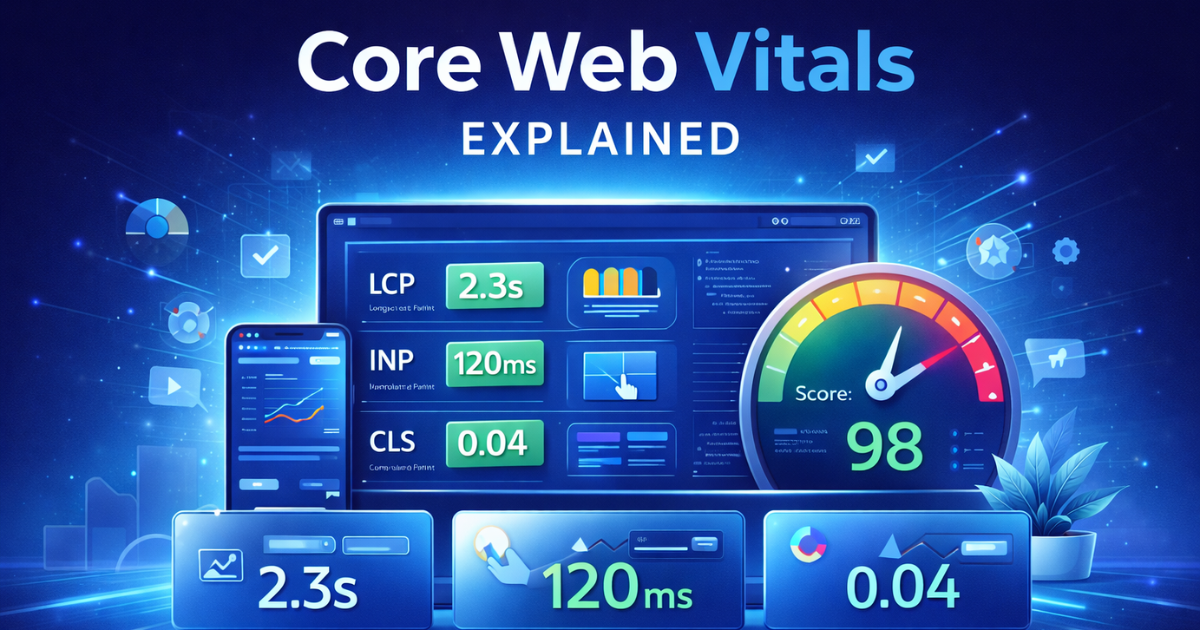
Website performance is no longer just a technical concern. It directly affects how your website ranks, how users interact with it, and how much revenue it generates. This is exactly why Google introduced Core Web Vitals as a ranking factor.
Performance metrics like Core Web Vitals are most effective when tracked as part of a holistic SEO strategy focused on real user experience.
If your website feels slow, unstable, or unresponsive, visitors leave and search engines notice. Core Web Vitals measure these experiences using real user data, not assumptions.
Understanding these metrics gives business owners a clear path to improving both SEO and conversions.
What Are Core Web Vitals?
Core Web Vitals are a set of performance metrics defined by Google to evaluate real-world user experience. They focus on how fast a page loads, how stable it is visually, and how responsive it feels during interaction.
Google currently measures three core metrics:
Largest Contentful Paint (LCP)
Interaction to Next Paint (INP)
Cumulative Layout Shift (CLS)
Each metric reflects a specific part of the user experience that directly impacts engagement and trust.
Largest Contentful Paint (LCP)
LCP measures how long it takes for the main content of a page to become visible to users. This is often a large image, headline, or hero section.
A good LCP score is under 2.5 seconds.
Poor LCP is usually caused by slow servers, unoptimized images, heavy scripts, or inefficient CSS delivery. When users wait too long to see meaningful content, they assume the site is slow and leave.
For businesses, slow LCP means higher bounce rates and lower conversion potential.
Interaction to Next Paint (INP)
INP measures how quickly a page responds when a user interacts with it, such as clicking a button or opening a menu.
A good INP score is under 200 milliseconds.
Websites with poor responsiveness feel laggy and frustrating. This often happens due to excessive JavaScript, heavy animations, or poorly structured front-end code.
If users click and nothing happens immediately, trust drops and abandonment increases.
Cumulative Layout Shift (CLS)
CLS measures how visually stable a page is while loading. It tracks unexpected layout movements, such as buttons shifting or content jumping.
A good CLS score is under 0.1.
Layout shifts cause users to click the wrong elements and create a poor experience. This is commonly caused by images without dimensions, late-loading fonts, or dynamic ads.
Visual stability is critical for professionalism and credibility.
Why Core Web Vitals Matter for SEO
Google uses Core Web Vitals as part of its ranking signals. While content and backlinks still matter, performance now plays a direct role in visibility.
Websites with strong Core Web Vitals tend to:
Rank more consistently
Index faster
Retain users longer
Convert more traffic
Poor performance limits the potential of even the best content.
How Core Web Vitals Impact Revenue
Performance issues cost businesses money in subtle but powerful ways.
Slow pages reduce conversions
Unstable layouts reduce trust
Laggy interactions reduce engagement
Studies consistently show that even a one-second delay can significantly reduce conversion rates. For lead-driven websites, this means fewer form submissions. For service businesses, it means fewer inquiries. For SaaS, it means lower trial sign-ups.
Performance is not an optimization luxury. It is a revenue driver.
Common Core Web Vitals Issues
Many websites struggle with Core Web Vitals due to avoidable mistakes.
Heavy page builders without optimization
Uncompressed images and videos
Too many third-party scripts
Lack of caching and CDN usage
Poor hosting environments
These issues often accumulate over time, especially after redesigns or feature additions.
How to Improve Core Web Vitals
Improving Core Web Vitals requires both technical and strategic changes.
Optimize images and media delivery
Use efficient CSS and JavaScript loading
Reduce unnecessary scripts
Improve server response times
Ensure mobile-first performance
Choose performance-focused hosting
The goal is not just to pass Google’s thresholds, but to create a fast, stable, and responsive experience for real users.
Monitoring Core Web Vitals
Core Web Vitals should be monitored continuously, not checked once and forgotten.
Use tools like:
Google Search Console
PageSpeed Insights
Real user monitoring tools
Track trends over time and address issues before they impact rankings or conversions.
Final Thoughts
Core Web Vitals represent a shift in how websites are evaluated. It is no longer enough to look good or rank for keywords. Websites must perform well for real users.
Businesses that prioritize performance gain a competitive advantage in search visibility, user trust, and revenue growth.
A fast website is not just better for SEO. It is better for business.