

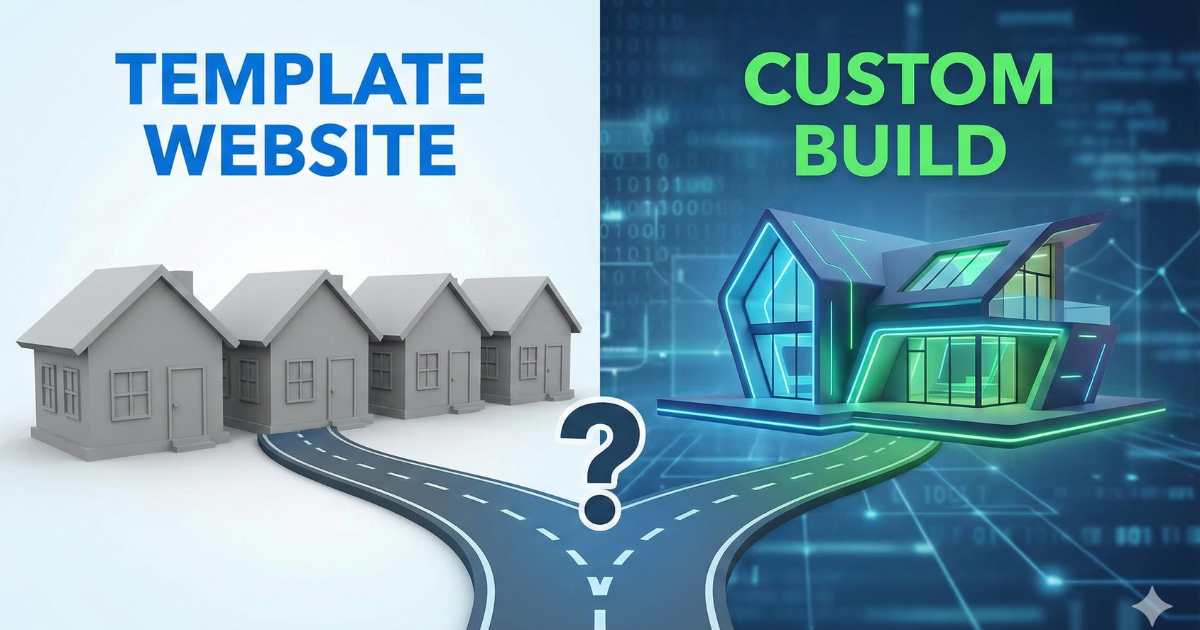
One of the first hurdles business owners face when planning a new website is the budget question. You start researching and quickly find two very different price brackets: the affordable, “ready-to-go” website template, and the significant investment of a custom build.
It feels like a choice between buying an off-the-rack suit versus getting one bespoked tailored. Both cover your body, but the fit, feel, and impression they make are vastly different.
At Netmatic, we work with dozens of platforms and approaches. We don’t believe one is inherently “better” than the other—but one is definitely better for your specific stage of business.
If you are struggling to decide where to allocate your budget, this guide will break down the pros, cons, and hidden realities of both approaches.
Choosing between a custom build and a template works best when guided by a clear web design strategy that aligns with your business goals, scalability needs, and long-term growth plans.
The Template Approach: The “Starter Home”
A template-based website (often used on platforms like Wix, Squarespace, or pre-bought WordPress themes) is a pre-designed structure. You buy the layout, and then you plug in your logo, text, and images.
The Pros
- Speed to Market: If you need a website up by Friday, a template is your best bet. The structure is already there; you just need to populate content.
- Lower Upfront Cost: This is the biggest draw. The initial investment is significantly lower than hiring a developer to start from scratch.
- Decent Initial Designs: Modern templates look good. In 2025, you rarely find “ugly” templates anymore. They are generally mobile-responsive out of the box.
The Hidden Cons
- The “Cookie-Cutter” Effect: Your website will look exactly like thousands of others. It’s hard to build a unique brand identity when you are using the same layout as your competitors.
- The “Bloat” Problem: Templates try to be everything to everyone. They come loaded with features, code, and design options you will never use. This extra code runs in the background, which frequently slows down page load speeds and hurts SEO.
- Difficult to Scale: You are confined to the “box” the template designer built. If you suddenly need a unique feature or a specific customer portal three months down the line, you might hit a wall where the template simply cannot do it without breaking.
The Custom Build Approach: The “Dream Home”
A custom build means starting with a blank canvas. Every pixel, button, and function is designed specifically for your business goals, your brand guidelines, and your customer’s needs.
The Pros
- Perfect Brand Fit: The design serves your brand, not the other way around. The user experience is tailored specifically to how your customers behave.
- Lean and Fast: A custom site only contains the code it needs to function. There is no bloat. This usually results in lightning-fast load times and better rankings on Google.
- Scalability and Longevity: Custom sites are built to grow with you. Adding complex integrations (like connecting to your CRM or inventory system) is much easier because the foundation is solid. A good custom build can last you 3–5 years, whereas businesses often outgrow templates in 12–18 months.
The Cons
- Higher Upfront Investment: It requires a team of skilled designers and developers, which costs more time and money than buying a $70 theme.
- Longer Timeline: You won’t launch in a week. A quality custom build takes weeks or months of planning, design, development, and testing.
Which Path Should You Choose?
At Netmatic, we help clients navigate this choice every day. Here is a simple framework to help you decide:
Choose a Template If:
- You are a brand-new startup testing an idea (Proof of Concept).
- Your budget is extremely tight
- You need the site live immediately.
- Your needs are simple (e.g., a 5-page brochure site to display contact info).
Choose a Custom Build If:
- You are an established business looking to scale or rebrand.
- Website performance (speed and SEO) is critical to your revenue.
- You have unique functionality needs (custom calculators, client portals, complex e-commerce).
- Your brand identity needs to stand out significantly from competitors.
The Middle Ground
Remember, it’s rarely black and white. You can have a “semi-custom” site where you start with a robust framework but heavily customize the design and functionality.
The most important thing is to align your website choice with your business goals. Don’t buy a Ferrari if you just need to pick up groceries, but don’t buy a bicycle if you need to haul lumber across the country.
If you’re unsure which route will give you the best return on investment, let’s talk. We can assess your current needs and future goals to recommend the perfect fit.