

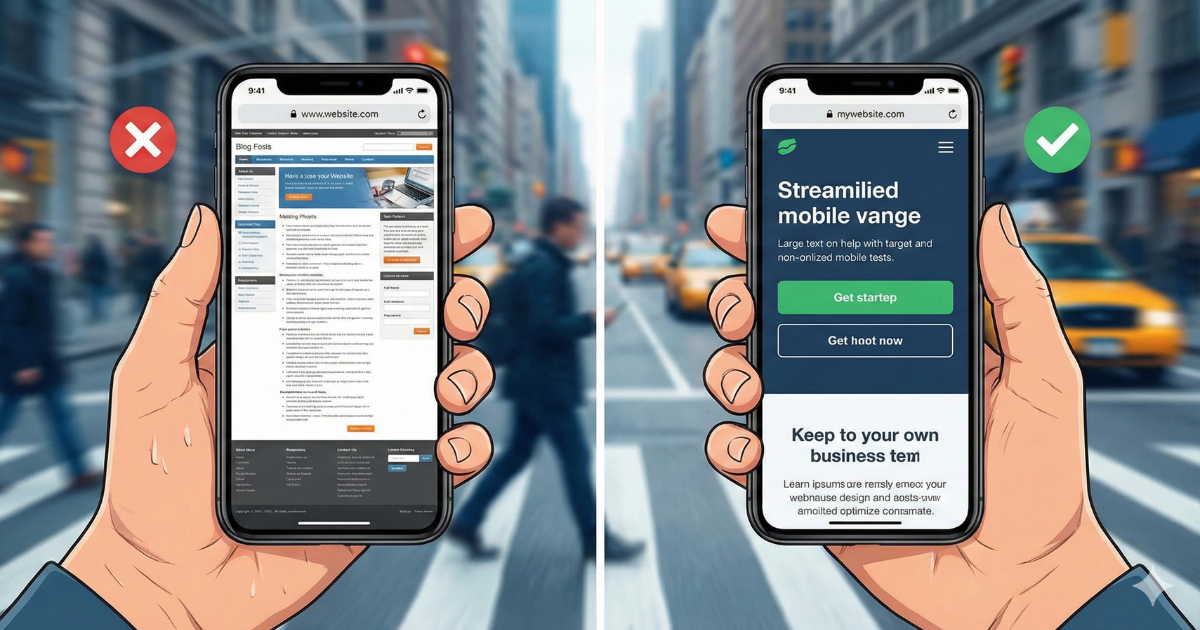
For years, “mobile-friendly” was a checkbox on a web developer’s to-do list. It meant building a desktop website first, and then making sure it didn’t look too broken on a smartphone.
In 2025, that mindset is obsolete.
Today, mobile traffic isn’t just a “segment” of your audience; for most industries, it is the audience. If you are still designing for a monitor first and a phone second, you are designing for the minority.
At NetMatic, we have shifted our entire strategy to Mobile-First. Here is why your business needs to do the same if you want to rank on Google and capture leads.
1. Google Has Stopped Looking at Your Desktop Site
This is the most critical technical update many business owners missed. Google now uses Mobile-First Indexing.
This means Google’s “bots” primarily crawl and rank the mobile version of your website. If your mobile site has less content, fewer keywords, or runs slower than your desktop site, your entire search ranking suffers. You could have the most beautiful desktop homepage in the world, but if the mobile version is lacking, you are invisible to Google.
2. The “Shrink” Fallacy vs. The “Thumb Zone”
A common mistake is thinking that “Responsive Design” just means shrinking things down to fit a smaller screen.
- The Problem: When you just shrink a desktop site, buttons become too small to tap, text requires zooming, and menus become impossible to navigate.
- The Solution (The Thumb Zone): Mobile-first design considers human physiology. We design navigation bars, “Buy Now” buttons, and forms specifically to be within easy reach of a user’s thumb while holding a phone one-handed.
If a user has to use two hands or pinch-to-zoom to use your site, you have failed the UX test.
3. Mobile Users Have Zero Patience
We mentioned in our previous post about website speed that speed kills conversions. This is doubly true on mobile.
Mobile users are often on data connections (4G/5G), not stable Wi-Fi. They are on the bus, in a line, or walking. They want answers now.
- Desktop User: Might wait 2–3 seconds.
- Mobile User: Will leave if it takes more than 1.5 seconds.
Mobile-first development focuses on loading the essentials first, deferring heavy images, and keeping the code lightweight so the experience feels instant.
4. B2B Buyers Are on Mobile Too
A dangerous myth is: “I sell to other businesses (B2B), so my clients are on desktop computers at work.”
Data shows that 70% of B2B queries start on a smartphone. Executives check vendors on their commute; managers approve purchases from their couch. If your B2B site looks clunky on an iPhone, you look like a dinosaur tech partner.
A successful mobile-first approach starts with understanding the fundamentals of mobile-first web design and how layout, performance, and usability work together.
How We Build Differently
At Netmatic, whether we are building in Webflow, WordPress, or HubSpot, we often start the design process with the mobile screen before we even look at the desktop version.
We ask:
- What is the ONE action the user needs to take here?
- Is the button big enough to tap without frustration?
- Does the menu open instantly?
Is Your Site Ready for the Mobile Era?
Open your website on your phone right now. Try to fill out your own contact form. Try to click the phone number.
Was it easy? Or was it work?
If it felt like work, you are losing customers. Let’s fix that.