

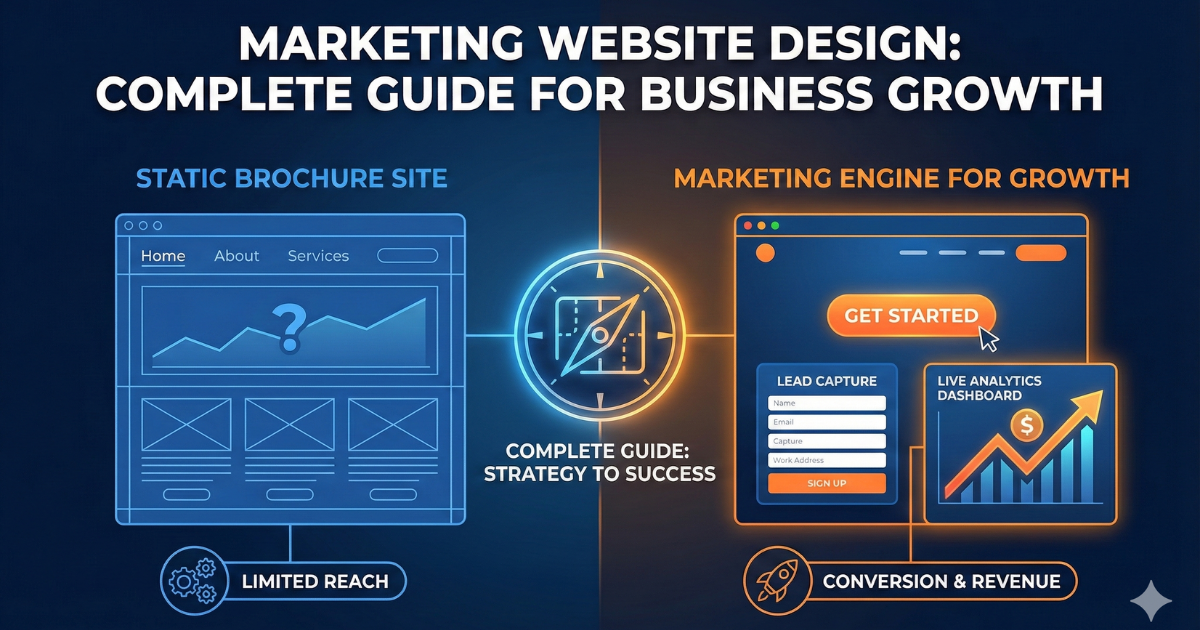
Marketing website design has evolved far beyond creating attractive pages to become the foundation of digital business growth. In 2025, the difference between generic website design and strategic marketing website design directly impacts lead generation, conversion rates, search rankings, and revenue growth.
At NetMatic Technologies, we’ve designed over 150 marketing websites across the Greater Toronto Area, generating an average of 73% more qualified leads within 90 days compared to traditional website approaches. Our “designers who think like developers” methodology ensures every design element serves both aesthetic and business objectives.
This guide reveals how marketing website design drives measurable business growth through strategic user experience, conversion optimization, and technical excellence that separates high-performing websites from digital brochures.
What Makes Marketing Website Design Different
Marketing websites are engineered specifically to convert visitors into leads and customers, unlike traditional websites that simply present information. Every design element, content placement, and user interaction is optimized to guide prospects through strategic conversion paths.
Conversion-First Architecture: Marketing websites prioritize lead generation through strategic placement of contact forms, compelling calls-to-action, and trust signals that address common purchase hesitations throughout the user journey.
Data-Driven Design Decisions: Unlike traditional design that relies on aesthetic preferences, marketing website design uses analytics, user behavior data, and conversion testing to optimize performance continuously.
Sales Process Integration: Marketing websites support the entire sales funnel from initial awareness through customer conversion by providing the right information at each stage of the buying process.
ROI Measurement Focus: Every design element can be measured and optimized for business results, making marketing website design a strategic investment rather than a cost center.
Core Elements of High-Converting Marketing Websites
Successful marketing websites incorporate specific design elements and strategies proven to increase lead generation and customer acquisition across industries and business sizes.
Strategic Value Proposition Presentation: The homepage immediately communicates what makes your business unique, who you serve, and why prospects should choose you over competitors through compelling headlines and visual hierarchy.
Trust Signal Architecture: Customer testimonials, case studies, industry certifications, security badges, and clear contact information are strategically placed to build credibility throughout the conversion process.
Conversion Path Optimization: Clear navigation, logical information flow, and prominent calls-to-action guide visitors toward desired actions without creating friction or confusion.
Mobile-First User Experience: With over 65% of business website traffic coming from mobile devices, marketing websites prioritize mobile performance, touch-friendly interfaces, and fast loading across all screen sizes.
Content That Sells: Marketing websites use benefit-focused copy that addresses customer pain points, demonstrates ROI, and builds confidence in purchasing decisions rather than just describing features.
Psychology-Based Design for Maximum Conversions
Understanding user psychology enables marketing website design decisions that naturally influence purchasing behavior while providing genuine value to potential customers.
Visual Hierarchy Strategy: Strategic use of size, color, contrast, and white space directs attention toward conversion elements while maintaining aesthetic appeal and professional credibility.
Cognitive Load Management: Marketing websites present complex information through progressive disclosure, clear sections, and logical flow that reduces mental effort required to understand value propositions.
Social Proof Implementation: Customer success stories, reviews, testimonials, and industry recognition are woven throughout the design to leverage social psychology principles that influence decision-making.
Urgency and Scarcity Elements: When appropriate, marketing websites include limited-time offers, availability indicators, or exclusive access elements that encourage prompt action without appearing manipulative.
Authority Building: Professional design, team credentials, industry expertise demonstrations, and thought leadership content establish the credibility necessary for high-value service purchasing decisions.
Technical Foundation for Marketing Success
Marketing websites require sophisticated technical implementation that supports both user experience excellence and search engine visibility necessary for organic lead generation.
Performance Optimization: Fast loading times directly impact conversion rates and search rankings. Marketing websites must load in under 2.5 seconds on mobile devices through optimized images, efficient code, and strategic resource loading.
Search Engine Optimization: Technical SEO implementation including proper heading structure, meta optimization, schema markup, and Core Web Vitals excellence ensures organic visibility for target keywords.
Conversion Tracking: Comprehensive analytics implementation tracks form submissions, phone calls, email contacts, and user behavior patterns that inform ongoing optimization decisions.
Security and Compliance: SSL certificates, privacy policy compliance, secure forms, and data protection measures build trust while protecting both business and customer information.
Scalability Architecture: Marketing websites must accommodate business growth, service expansion, and evolving market needs without requiring complete rebuilds.
Lead Generation Optimization Strategies
Effective marketing websites implement sophisticated lead generation strategies that capture prospect information while providing value and building relationships.
Multiple Conversion Paths: Different prospects prefer different contact methods. Marketing websites offer contact forms, phone numbers, live chat, email addresses, and scheduling links appropriately throughout the user journey.
Lead Magnets and Content Offers: Valuable resources like guides, checklists, consultations, or assessments provide reasons for prospects to share contact information in exchange for immediate value.
Progressive Profiling: Forms request minimal initial information then gradually collect additional details through subsequent interactions, reducing abandonment while building comprehensive prospect profiles.
Automated Follow-Up Integration: Marketing websites connect with email marketing, CRM systems, and automated nurturing sequences that maintain engagement with prospects through the sales process.
Personalization Opportunities: Advanced marketing websites adapt content, offers, and messaging based on visitor behavior, traffic sources, or demographic information to increase relevance and conversion rates.
Measuring Marketing Website Performance
Marketing websites require systematic measurement and analysis to optimize performance and demonstrate return on investment through data-driven decision making.
Conversion Rate Analysis: Track overall conversion rates and analyze performance by traffic source, device type, landing page, and user journey to identify optimization opportunities.
Lead Quality Assessment: Monitor lead-to-customer conversion rates, average deal size, and sales cycle length to evaluate not just lead quantity but prospect quality improvements.
User Experience Metrics: Bounce rates, time on page, pages per session, and task completion rates reveal user experience quality and content effectiveness across different sections.
Revenue Attribution: Connect website performance to actual revenue generation through customer lifetime value analysis, sales attribution, and ROI calculations that justify design investments.
Competitive Benchmarking: Regular analysis of competitor websites, industry benchmarks, and market trends ensures marketing website performance remains competitive and current.
Industry-Specific Marketing Website Considerations
Different industries require unique approaches to marketing website design based on customer behavior patterns, decision-making processes, and regulatory requirements.
Professional Services: Trust-building through credentials, case studies, thought leadership content, and clear service explanations that address complex purchasing decisions and long sales cycles.
Healthcare and Medical: Privacy compliance, accessibility requirements, appointment scheduling integration, and patient education content that builds confidence in care quality.
Technology and SaaS: Product demonstration capabilities, trial conversions, feature explanation, integration details, and technical credibility that supports software purchasing decisions.
Manufacturing and B2B: Detailed product information, capability demonstrations, quality certifications, and contact facilitation for complex sales processes involving multiple decision-makers.
Local Service Businesses: Location-based optimization, service area coverage, emergency contact options, and local reputation management that captures immediate service needs.
Common Marketing Website Design Mistakes
Understanding and avoiding common mistakes prevents lost conversion opportunities and ensures marketing websites achieve their full business potential.
Generic Template Usage: Template-based designs cannot accommodate unique value propositions, industry requirements, or conversion optimization strategies that drive business results.
Feature-Focused Content: Describing what you do instead of why customers should care creates disconnect between business capabilities and customer needs or desired outcomes.
Poor Mobile Experience: Mobile users have different expectations and behavior patterns requiring dedicated optimization rather than simple responsive scaling of desktop designs.
Weak Calls-to-Action: Generic phrases like “Learn More” or “Contact Us” fail to communicate value or create urgency that motivates prospects to take immediate action.
Missing Trust Signals: Lack of customer testimonials, security indicators, contact information, or credibility markers increases perceived risk and reduces conversion likelihood.
Future of Marketing Website Design
Emerging technologies and changing user expectations continue evolving marketing website requirements, making forward-thinking design decisions crucial for long-term success.
AI and Personalization: Machine learning enables dynamic content adaptation, personalized user experiences, and automated optimization that improves conversion rates over time without manual intervention.
Voice Search Optimization: Growing voice search usage requires content optimization for conversational queries and local intent that captures voice-driven business discovery.
Privacy-First Design: Increasing privacy regulations and user awareness require transparent data collection, consent management, and privacy-conscious marketing approaches.
Interactive Experiences: Advanced interactive elements, calculators, assessments, and dynamic content create engagement opportunities that differentiate marketing websites from static competitors.
Integration Complexity: Marketing websites must seamlessly connect with CRM systems, marketing automation, analytics platforms, and business tools that support comprehensive customer relationship management.
What is the ROI of professional marketing website design?
Professional marketing website design typically delivers 300-600% ROI within 12 months through increased lead generation, higher conversion rates, and improved customer acquisition efficiency. Businesses investing $15,000-$25,000 in strategic marketing website design often see $50,000-$150,000 in additional revenue annually.
How long does it take to see results from marketing website design?
Most businesses see measurable improvements in lead generation within 30-60 days of launching professionally designed marketing websites. Search engine optimization benefits typically appear after 90-180 days, while full optimization and maximum performance usually develop over 6-12 months of continuous improvement.
What makes marketing websites different from regular business websites?
Marketing websites are specifically designed to convert visitors into leads and customers through strategic user experience, conversion optimization, and sales process integration. Regular websites focus on information presentation, while marketing websites prioritize business results through every design decision.
How much should businesses budget for marketing website design?
Marketing website design investment should align with business revenue and growth objectives. Companies generating $500,000-$2 million annually typically invest $10,000-$25,000, while larger enterprises often require $25,000-$75,000 for comprehensive marketing website solutions with advanced functionality.
Can marketing website design work for B2B companies?
Yes, marketing website design is especially effective for B2B companies because it addresses complex decision-making processes, multiple stakeholders, and longer sales cycles through strategic content presentation, trust building, and lead nurturing integration that supports relationship development.
Do marketing websites require ongoing optimization?
Yes, successful marketing websites require continuous optimization based on performance data, user feedback, and changing market conditions. Monthly analysis and quarterly improvements ensure marketing websites maintain peak performance and competitive advantages over time.
How do you measure marketing website success?
Marketing website success is measured through conversion rates, lead quality, revenue attribution, cost per acquisition, customer lifetime value, and return on investment. Advanced tracking reveals which design elements, content sections, and user flows generate the highest business value.
What industries benefit most from marketing website design?
Professional services, healthcare, technology, manufacturing, and high-value service businesses benefit most from marketing website design because they involve complex purchasing decisions, relationship building, and trust development that strategic design supports effectively.
Transform Your Website Into a Lead Generation Engine
Marketing website design represents one of the highest-ROI investments businesses can make in sustainable growth strategy. The difference between generic web design and strategic marketing website design is the difference between an online brochure and a 24/7 sales and marketing system.
Businesses that invest in professional marketing website design consistently outperform competitors in lead generation, customer acquisition, and revenue growth. By focusing on conversion optimization, user experience excellence, and technical performance, marketing websites become powerful business assets that deliver measurable results.
Ready to transform your website into a powerful marketing engine? NetMatic Technologies specializes in creating marketing websites that combine stunning design with conversion optimization and technical excellence. Our “designers who think like developers” approach ensures your website delivers both visual impact and measurable business growth.
A strong marketing site is built on a clear web design strategy that balances messaging, layout, and conversion goals.
Contact NetMatic today for a comprehensive website analysis and customized marketing website strategy that drives real business results.
Ready to Build Your New Website?
Schedule a free 15-minute discovery call. No pressure, just strategy.