

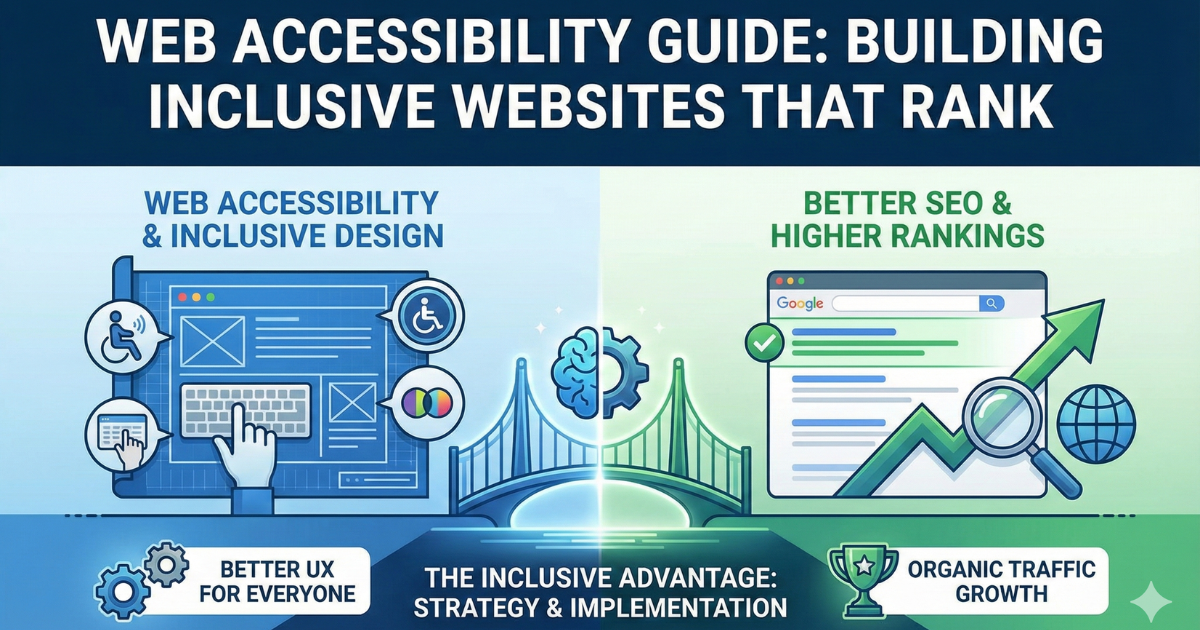
Web accessibility has evolved from compliance requirement to competitive business advantage in 2025. Beyond legal obligations, accessible websites achieve better search rankings, reach larger audiences, and demonstrate the technical expertise that separates professional agencies from template-based competitors.
At NetMatic Technologies, we’ve implemented accessibility improvements across over 100 websites throughout the Greater Toronto Area, delivering an average 23% increase in organic traffic and 31% improvement in user engagement while ensuring legal compliance and inclusive user experiences.
This comprehensive guide reveals how accessibility-first design drives business growth through improved SEO performance, expanded market reach, and the technical differentiation that positions businesses as industry leaders.
Accessibility works best when it is built into a broader web design strategy that prioritizes usability, performance, and inclusive experiences from the start.
Why Web Accessibility Drives Business Growth
Web accessibility represents far more than regulatory compliance—it’s a strategic business investment that impacts search rankings, user experience quality, and competitive positioning in meaningful ways.
SEO Performance Enhancement: Google’s algorithms increasingly favor accessible websites because accessibility best practices align with search engine requirements. Proper heading structure, alt text, semantic markup, and logical navigation improve both user experience and search visibility.
Market Reach Expansion: Over 15% of the global population has some form of disability, representing a significant market opportunity for businesses that prioritize inclusive design. Accessible websites capture this audience while providing better experiences for all users.
Legal Risk Mitigation: Accessibility lawsuits have increased dramatically, with businesses facing significant financial penalties and reputational damage. Proactive accessibility compliance eliminates legal exposure while demonstrating corporate responsibility.
Technical Excellence Demonstration: Implementing comprehensive accessibility requires sophisticated understanding of web standards, semantic markup, and progressive enhancement that showcases true technical expertise to potential clients and competitors.
Core Accessibility Principles for Business Websites
Effective accessibility implementation follows established principles that create inclusive experiences while supporting business objectives through improved performance and user satisfaction.
Perceivable Content: All information must be presentable in ways users can perceive, including alternative text for images, captions for videos, sufficient color contrast, and content that works with assistive technologies.
Operable Interfaces: Website functionality must be operable by all users, including keyboard navigation, adequate time limits for task completion, seizure-safe content, and navigation that supports different interaction methods.
Understandable Information: Content and user interface operation must be understandable through clear language, predictable functionality, and input assistance that helps users avoid and correct mistakes.
Robust Technology: Content must be robust enough for interpretation by assistive technologies, browsers, and other user agents through valid code, semantic markup, and progressive enhancement techniques.
SEO Benefits of Accessible Web Design
Search engines and accessibility requirements share many common goals, making accessible websites naturally better optimized for search visibility and organic traffic growth.
Semantic HTML Structure: Accessible websites use proper heading hierarchies, semantic markup, and logical document structure that search engines rely on to understand content organization and relevance.
Alternative Text Optimization: Descriptive alt text for images serves both screen reader users and search engines, providing content context that improves image search visibility and overall page relevance.
User Experience Signals: Accessible websites typically have lower bounce rates, longer session durations, and higher user engagement—all factors that Google considers when evaluating content quality and search rankings.
Mobile Performance: Many accessibility features improve mobile usability, supporting Google’s mobile-first indexing and Core Web Vitals requirements that directly impact search rankings.
Content Quality: Accessibility guidelines encourage clear, well-structured content that benefits both disabled users and search engine understanding, improving organic visibility for target keywords.
Technical Implementation of Web Accessibility
Professional accessibility implementation requires sophisticated technical knowledge and systematic approach that demonstrates the advanced capabilities that separate expert agencies from basic service providers.
Semantic HTML and ARIA Integration
Proper Heading Structure: Logical heading hierarchy (H1, H2, H3) creates content organization that assistive technologies and search engines can understand and navigate effectively.
Landmark Regions: HTML5 semantic elements (header, nav, main, aside, footer) provide page structure context that improves navigation for screen readers and search engine crawling.
ARIA Labels and Descriptions: Accessible Rich Internet Applications attributes provide additional context for complex interactive elements that enhance both accessibility and SEO value.
Form Accessibility: Proper labeling, error identification, and input assistance ensure form usability for all users while supporting conversion optimization objectives.
Visual and Interactive Design
Color Contrast Compliance: WCAG AA contrast ratios ensure readability for users with visual impairments while creating professional appearance that builds trust and credibility.
Focus Management: Visible focus indicators and logical tab order support keyboard navigation while demonstrating attention to user experience details that impress potential clients.
Responsive Typography: Scalable text that respects user preferences and maintains readability across devices supports both accessibility and mobile-first design requirements.
Touch Target Sizing: Adequate spacing and sizing for interactive elements improves usability for users with motor disabilities while enhancing mobile user experience.
Content Strategy for Accessible Websites
Accessible content strategies create inclusive experiences while supporting business communication objectives and search engine optimization requirements.
Plain Language Writing: Clear, concise content serves users with cognitive disabilities while improving comprehension and engagement for all visitors, supporting conversion optimization goals.
Logical Information Architecture: Well-organized content structure helps users find information efficiently while creating the logical flow that search engines favor for ranking purposes.
Multi-Format Content: Providing information in multiple formats (text, audio, video, infographics) serves diverse learning preferences while creating rich content that performs well in search results.
Error Prevention and Recovery: Clear instructions, input validation, and error correction support successful task completion while reducing friction in conversion processes.
Testing and Validation for Accessibility Compliance
Comprehensive accessibility testing requires systematic approach using multiple tools and techniques that ensure compliance while identifying optimization opportunities.
Automated Testing Tools: Screen reader testing, color contrast analyzers, and accessibility scanners identify common issues quickly while providing baseline compliance assessment.
Manual Testing Procedures: Keyboard navigation testing, screen reader evaluation, and user journey analysis reveal issues that automated tools cannot detect reliably.
Real User Testing: Involving users with disabilities in testing processes provides authentic feedback about actual usability challenges and improvement opportunities.
Ongoing Monitoring: Regular accessibility audits ensure continued compliance as content changes and new features are added to websites over time.
Business ROI of Accessibility Investment
Accessibility implementation delivers measurable business returns that justify investment costs while providing competitive advantages in multiple market areas.
Legal Cost Avoidance: Proactive accessibility compliance prevents costly lawsuits, with settlements often exceeding $100,000 plus ongoing legal fees and reputation damage.
Market Expansion: Accessible websites can capture disability market spending of over $490 billion annually while improving experiences for aging populations and temporary disability situations.
SEO Performance Gains: Accessibility improvements typically result in 15-30% increases in organic search traffic through better technical optimization and user experience signals.
Brand Reputation Enhancement: Demonstrating commitment to inclusion builds positive brand perception while differentiating from competitors who neglect accessibility considerations.
Industry-Specific Accessibility Considerations
Different industries have unique accessibility requirements and opportunities based on user demographics, regulatory environments, and business objectives.
Healthcare and Medical: HIPAA compliance intersects with accessibility requirements, while patient populations often include higher percentages of users with disabilities requiring comprehensive accessibility features.
Government and Public Services: Section 508 compliance mandates accessibility for government websites, while public service missions align naturally with inclusive design principles.
Education and Training: Educational content must serve diverse learning needs while complying with accessibility requirements that ensure equal educational opportunities.
Financial Services: Accessibility compliance supports regulatory requirements while building trust with customers who need alternative interaction methods for complex financial decisions.
E-commerce and Retail: Accessible shopping experiences capture broader customer base while reducing abandonment rates through improved usability and clear navigation.
Advanced Accessibility Features and Implementation
Sophisticated accessibility implementation goes beyond basic compliance to create exceptional user experiences that demonstrate technical excellence and business commitment to inclusion.
Progressive Enhancement: Building core functionality that works for all users, then adding enhanced features for users with more capable devices or assistive technologies.
Customizable User Preferences: Allowing users to adjust text size, color schemes, animation preferences, and other display options to meet individual accessibility needs.
Multi-Language Support: Implementing accessibility features that work across multiple languages and cultural contexts for global audience reach.
Voice Interface Integration: Adding voice commands and audio feedback that enhance accessibility while providing modern interaction options for all users.
What are the main benefits of web accessibility for businesses?
Web accessibility provides legal compliance protection, SEO performance improvements, expanded market reach, enhanced user experience, and competitive differentiation. Businesses typically see 15-30% increases in organic traffic and reduced legal risk while capturing the disability market worth over $490 billion annually.
Does web accessibility improve SEO rankings?
Yes, web accessibility significantly improves SEO performance because accessible websites use semantic HTML structure, proper headings, alt text, and logical navigation that search engines favor. Many accessibility best practices directly align with Google’s ranking factors and Core Web Vitals requirements.
What is the cost of implementing web accessibility?
Web accessibility implementation typically costs 10-20% additional investment during new website development, or 15-25% of website value for retrofitting existing sites. However, accessibility improvements often pay for themselves through improved SEO performance, expanded audience reach, and legal risk reduction.
How do you test website accessibility compliance?
Accessibility testing combines automated tools (WAVE, axe, Lighthouse) with manual testing including keyboard navigation, screen reader evaluation, and real user testing with people who have disabilities. Professional audits should include both technical compliance and actual usability assessment.
What are WCAG guidelines and compliance levels?
Web Content Accessibility Guidelines (WCAG) provide international standards for web accessibility with three compliance levels: A (basic), AA (standard), and AAA (enhanced). Most businesses target WCAG 2.1 AA compliance, which satisfies legal requirements while providing comprehensive accessibility coverage.
Can accessibility features affect website performance?
Properly implemented accessibility features typically improve website performance through semantic HTML, efficient navigation, and clean code structure. However, poorly implemented accessibility can impact performance, making professional implementation crucial for optimal results.
Is web accessibility legally required for all websites?
Legal requirements vary by location and business type, but accessibility laws increasingly apply to most commercial websites. The Americans with Disabilities Act (ADA) in the US, Accessibility for Ontarians with Disabilities Act (AODA) in Canada, and similar laws worldwide create compliance obligations for many businesses.
How does accessibility impact user experience for everyone?
Accessibility improvements benefit all users through clearer navigation, better content structure, improved mobile experience, and more intuitive interfaces. Features designed for disabilities often enhance usability for temporary impairments, situational limitations, and aging populations.
Transform Your Website Into an Inclusive Business Asset
Web accessibility represents a strategic business investment that delivers measurable returns through improved search performance, expanded market reach, and demonstrated technical excellence. The businesses that lead their industries understand that accessibility creates competitive advantages while fulfilling moral obligations to inclusive design.
Professional accessibility implementation requires sophisticated technical knowledge and systematic approach that goes beyond basic compliance to create exceptional user experiences. By investing in accessibility-first design, businesses protect against legal risks while capturing market opportunities that competitors miss.
Ready to transform your website into an accessible, high-performing business asset? NetMatic Technologies combines accessibility expertise with conversion optimization and technical excellence. Our “designers who think like developers” approach ensures your website meets the highest accessibility standards while driving measurable business results.
Contact NetMatic today for a comprehensive accessibility audit and implementation strategy that protects your business while expanding your market reach.
Ready to Build Your New Website?
Schedule a free 15-minute discovery call. No pressure, just strategy.